Battery Research: The Distribution of Lithium Isotopes Serves as a "Fingerprint" for Aging Processes
New diagnostic method detects battery degradation earlier than capacity measurement
Advertisement


The service life of lithium-ion batteries is limited by complex aging processes, the causes of which are often difficult to distinguish from one another. Researchers at the Federal Institute for Materials Research and Testing (BAM) have shown that the distribution of two lithium isotopes within the cells acts as a “fingerprint” directly linked to the degradation processes. This connection opens up new possibilities for better understanding aging mechanisms and optimizing batteries in a more targeted manner.
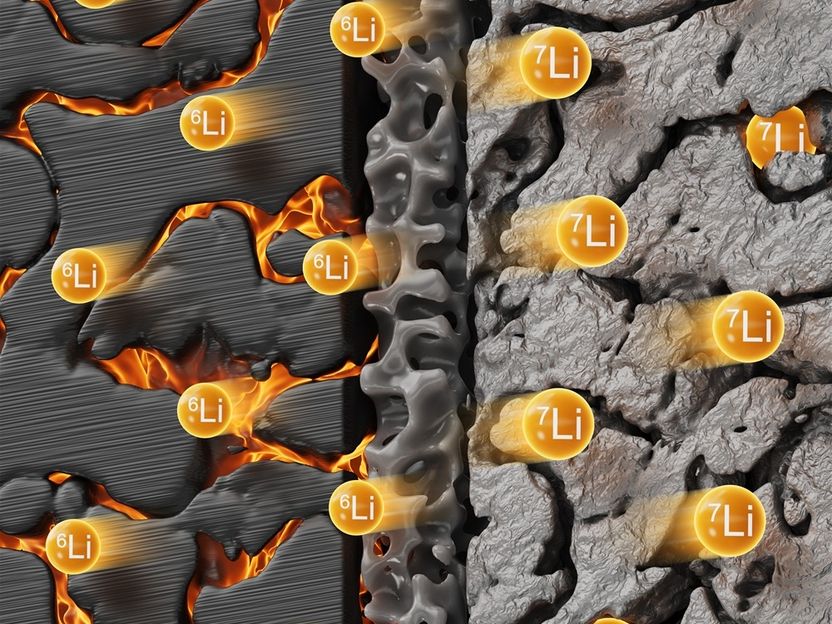
The distribution of lithium isotopes 6 and 7 in a cell leaves a characteristic fingerprint and can serve as a diagnostic tool for aging processes.
BAM
Lithium-ion batteries are a key technology for the energy transition. Despite continuous advances in performance and lifespan, however, one central problem remains unsolved: Cells age with every charge and discharge cycle. Their capacity decreases and their performance declines.
Several complex processes inside the battery are responsible for this. To date, the challenge of clearly identifying these aging mechanisms and distinguishing them from one another remains unresolved. While conventional diagnostic methods show that a battery is aging, they often provide only limited information about when, where, and by what mechanism the degradation is triggered.
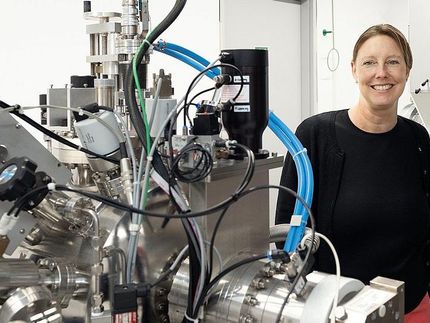
A BAM team led by Carlos Abad and Beatrice Battistella has developed a new approach, which was published in the journal ACS Energy Letters. The researchers use the distribution of two lithium isotopes within a cell as a diagnostic tool for aging processes. Their characteristic traces and patterns provide a fingerprint of the underlying degradation mechanisms.
The method takes advantage of the fact that natural lithium consists of two isotopes: lithium-6 and the slightly heavier lithium-7. These are variants of the same chemical element with different numbers of neutrons. In new batteries, both lithium isotopes are distributed in the same ratio as in all natural occurrences of the alkali metal—that is, in a ratio of 2.4 to 97.6 percent. Specifically, the researchers investigated a lithium battery with a cathode made of lithium-nickel-manganese-cobalt oxide (NMC) and a graphite anode. Already after the first few charging cycles, lithium-6 accumulated preferentially at the anode. After another 280 cycles, this effect intensified, while the cathode exhibited significantly higher lithium-7 content. At the same time, the capacity of the cells decreased.
This finding was made possible by a high-resolution form of mass spectrometry that allowed the distribution of lithium isotopes to be determined layer by layer across the entire depth of the electrodes. The research was conducted in collaboration with Nu Instruments Ltd. in the United Kingdom and the Leibniz Institute for Solid State and Materials Research Dresden (IFW Dresden).
“The distribution of lithium isotopes thus provides direct information about aging processes in lithium-ion batteries. The isotopes act as natural markers. Their distribution shows us how lithium moves during battery operation and where changes occur,” said Beatrice Battistella. The researchers were also able to demonstrate that these traces are closely linked to the batteries’ capacity loss.
For Beatrice Battistella and Carlos Abad, the significance of the findings lies primarily in their potential applications for precise measurements: Instead of detecting aging solely based on capacity loss, it could be tracked much earlier in the future using the traces left by lithium isotopes in the battery cell. This enables a more precise understanding of aging mechanisms and is ultimately crucial for improving batteries in a targeted manner and predicting their lifespan more accurately.
Note: This article has been translated using a computer system without human intervention. LUMITOS offers these automatic translations to present a wider range of current news. Since this article has been translated with automatic translation, it is possible that it contains errors in vocabulary, syntax or grammar. The original article in German can be found here.
Original publication
Beatrice Battistella * ; Adam Revill; Cornel Venzago; Volker Hoffmann; Leonardo Agudo Jácome; Dominik Al-Sabbagh; Sebastian Recknagel; Carlos Abad *; Depth-Resolved Lithium Isotope Fractionation as a Diagnostic of Interphase Evolution and Degradation in Lithium-Ion Batteries; ACS Energy Lett. (2026) 11 (3): 2851–2857.


Other news from the department science















These products might interest you


Most read news








More news from our other portals

























See the theme worlds for related content
Topic World Mass Spectrometry
Mass spectrometry enables us to detect and identify molecules and reveal their structure. Whether in chemistry, biochemistry or forensics - mass spectrometry opens up unexpected insights into the composition of our world. Immerse yourself in the fascinating world of mass spectrometry!

Topic World Mass Spectrometry
Mass spectrometry enables us to detect and identify molecules and reveal their structure. Whether in chemistry, biochemistry or forensics - mass spectrometry opens up unexpected insights into the composition of our world. Immerse yourself in the fascinating world of mass spectrometry!
Topic World Battery Technology
The topic world Battery Technology combines relevant knowledge in a unique way. Here you will find everything about suppliers and their products, webinars, white papers, catalogs and brochures.

Topic World Battery Technology
The topic world Battery Technology combines relevant knowledge in a unique way. Here you will find everything about suppliers and their products, webinars, white papers, catalogs and brochures.